Smart Lighting Trends 2026: How Technology and Design Are Redefining Modern Spaces
Lighting has evolved far beyond its role as a purely functional element in the home. Today, it is a critical lifestyle and design component, shaping how people experience, perceive, and interact with their living and working spaces. As homeowners become more design-conscious and technology-forward, integrators, designers, and architects have played a key role in elevating lighting through smart home automation, advanced fixtures, and adaptive control systems.
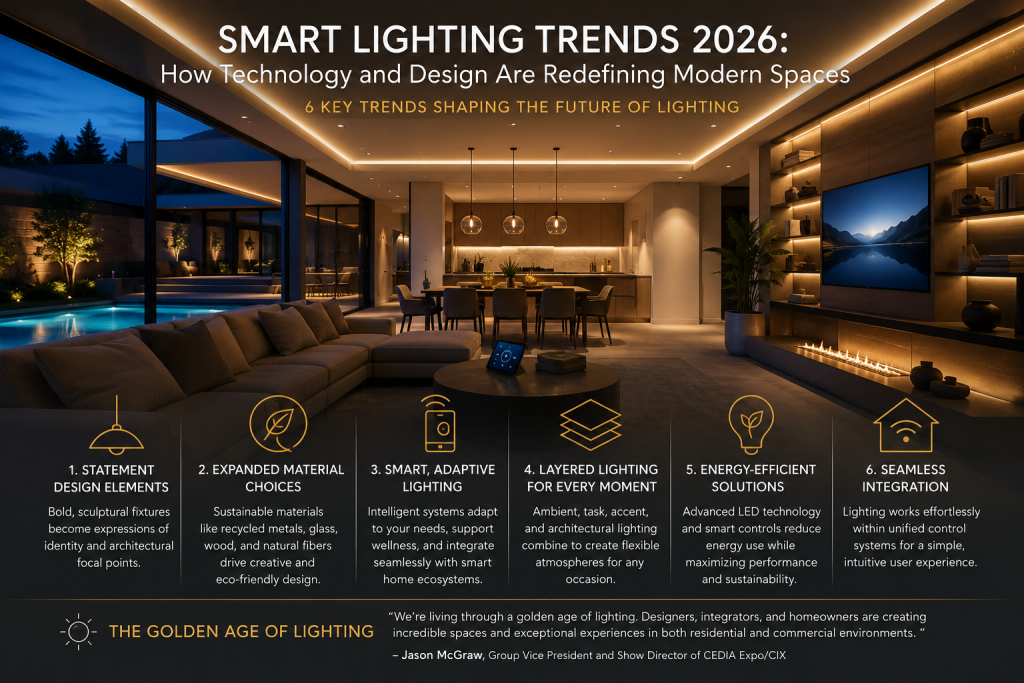
Insights from CEDIA Expo/CIX 2025 and leading industry sources reveal six major lighting technology trends set to define residential and commercial lighting in 2026.
1. Lighting Fixtures Become Statement Design Elements
One of the most notable lighting trends heading into 2026 is the rise of statement lighting fixtures. Rather than fading into the background, fixtures are increasingly being used as expressions of identity and architectural focal points.
From sculptural chandeliers to oversized pendants and minimalist ceiling installations, designers and integrators are embracing bold forms that anchor a space visually. Designers like Lindsey Adelman exemplify this shift, using hand-blown glass, resin, and even 3D-printed metal components to create lighting that doubles as art.
Publications such as House Beautiful have also highlighted the growing demand for truly custom lighting solutions, reinforcing integrators’ role in delivering highly personalized environments.
2. Expanded Material Choices Drive Creative and Sustainable Design
The lighting industry has seen a dramatic expansion in material options, opening new creative possibilities for both residential and commercial projects. Recycled metals, hand-blown glass, natural fibers, wood, and biophilic materials are now common components in modern fixtures.
According to John Cullen Lighting, materials like linen and organic textures are being used to add warmth and tactility to contemporary interiors. This trend also aligns with the growing focus on sustainable lighting design, giving environmentally conscious homeowners options that combine aesthetics with responsible building practices.
3. Smart, Adaptive Lighting Takes Center Stage
Smart lighting has moved well beyond basic on/off or color-changing features. In 2026, lighting systems are increasingly adaptive, personalized, and integrated into broader smart home ecosystems.
Advanced solutions allow integrators to design custom lighting scenes based on brightness, color temperature, and even circadian rhythm support. Exhibitors at CEDIA Expo/CIX, including Deako, Yeelight, and AiSPIRE, showcased lighting solutions that blend lifestyle design with simplified control, making advanced lighting more accessible without sacrificing sophistication.
4. Layered Lighting Enhances Flexibility and Atmosphere
Layered lighting continues to be a cornerstone of modern lighting design. By combining ambient, task, accent, and architectural lighting, integrators can create spaces that are both visually dynamic and functionally versatile.
Techniques such as under-cabinet lighting, recessed LED strips, sconces, and soffit lighting are now standard tools. According to Bryan Hindman Electric, layered lighting allows spaces like media rooms or home offices to transition seamlessly between multiple use cases—bright and functional during the day, warm and immersive at night.
This modular approach aligns naturally with smart lighting control systems, allowing for effortless scene changes.
5. Energy-Efficient Lighting Delivers Greater Impact
Energy efficiency remains a driving force in lighting innovation. Modern LED lighting systems consume significantly less power while lasting far longer than previous generations.
Manufacturers like Environmental Lights have developed proprietary technologies to extend LED lifespan even further, reducing maintenance and long-term costs.
When paired with intelligent lighting controls, these systems help homeowners optimize energy usage—supporting broader trends toward sustainability, efficiency, and partial grid independence.
6. Seamless Integration Simplifies Lighting Control
The final trend shaping lighting in 2026 is seamless integration. Smart lighting now works effortlessly within larger home automation and building management systems. Refined user interfaces, app-based controls, and AI-driven voice commands have made lighting more intuitive than ever.
In commercial environments, companies like Accio note that integrating lighting with broader building automation systems enables consistent experiences across multiple spaces while delivering operational efficiencies for facility managers.
The Golden Age of Lighting
“We’re living through a golden age of lighting,” says Jason McGraw, Group Vice President and Show Director of CEDIA Expo/CIX. “Designers, integrators, and homeowners are creating incredible spaces and exceptional experiences in both residential and commercial environments.”
As lighting continues to blend design, technology, energy efficiency, and automation, its role in shaping modern spaces will only grow. For integrators and design professionals, 2026 represents a powerful opportunity to leverage smart lighting as both a functional necessity and a defining element of lifestyle-driven environments.